

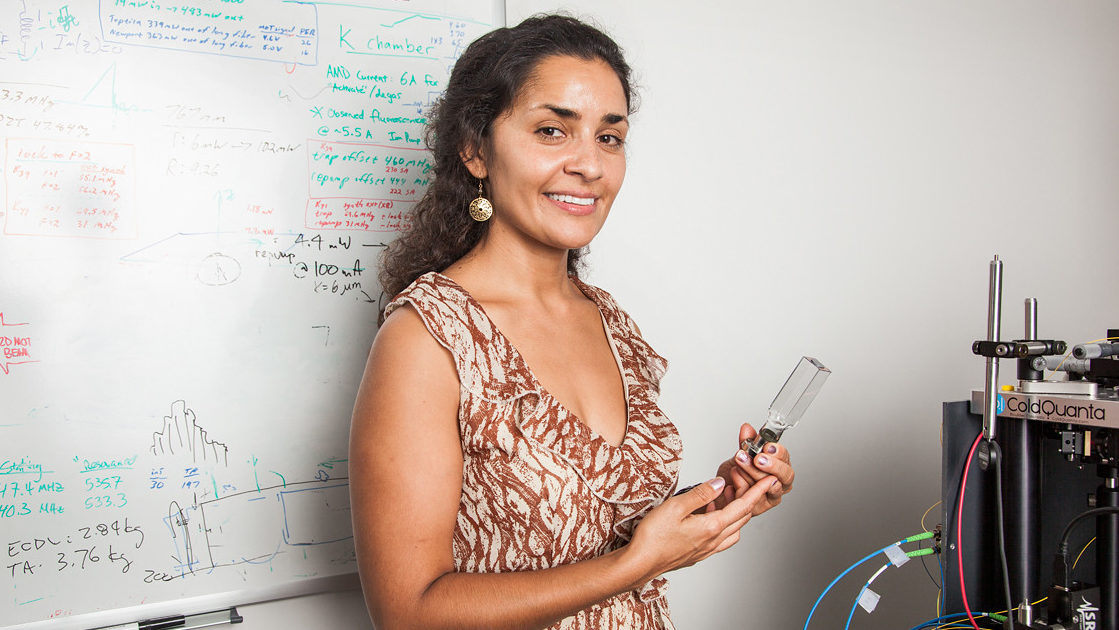
An Indian-origin scientist Anita Sengupta’s project of cooling atoms reached International Space Station (ISS) on Thursday.
Since low temperature is important for various experiments, National Aeronautics and Space Administration’s (NASA) Cold Atom Laboratory (CAL) reached International Space Station (ISS) on Thursday to study what happens to atoms when they become very cold.
Sengupta was the project manager of this mission and led the NASA team to design, develop and fabricate along with integrating and testing of the CAL mission during 2012 to 2017.
Read More: Third death from Coronavirus in India
In Space, the laboratory is likely to be 10 billion times colder than the vacuum of space which will facilitate the experts to study these atoms for a longer period of time in the microgravity. NASA is expecting the laboratory will boost sensors, quantum computers and atomic clocks among other technologies.
To cool down the atoms, atoms will be made motionless. The laboratory uses a powerful vacuum chamber and lasers but eliminating the gravity is the most important thing.
Sengupta had played the pivotal role in landing of Curiosity rover on the surface of Mars in 2012 by discovering “supersonic parachute system”, which is also known as the “seven minutes of terror”.
Read More: Editor & former Rajya Sabha MP Chandan Mitra dies
Sengupta was born to an Indian father and British mother in Glasgow and shifted to the United States to pursue he graduation. She also worked on the ion propulsion system for Dawn Mission during her 15-year tenure in NASA’s Jet Propulsion Laboratory.



Leave a Reply