
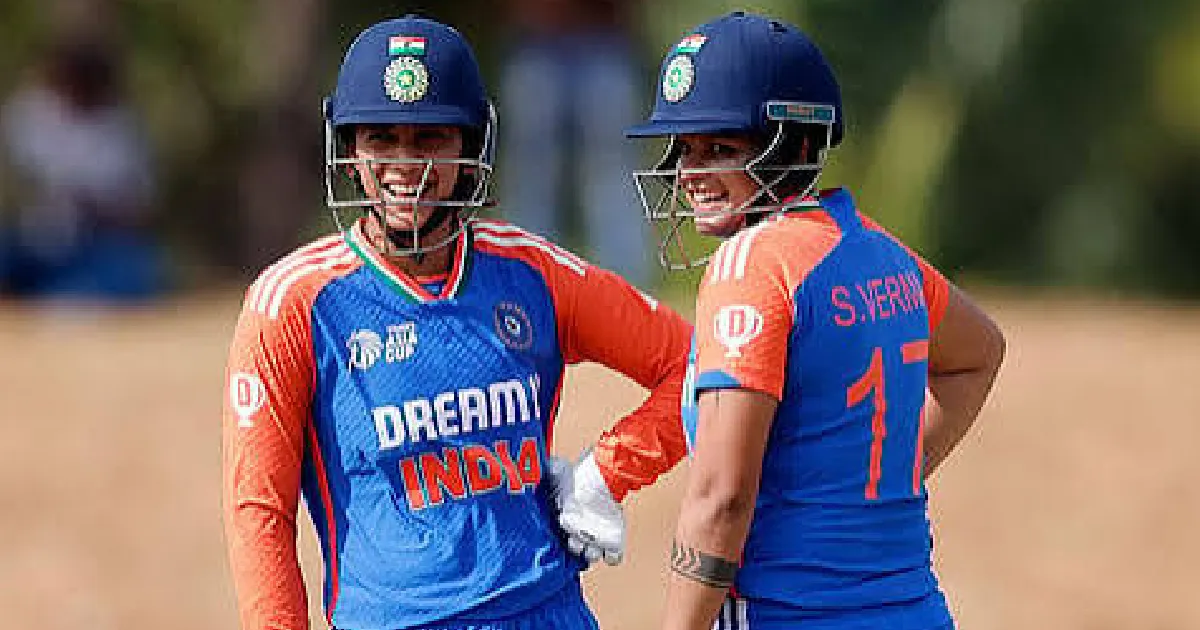
The Bengal Story Bureau: India’s top-order blueprint at the ongoing ICC Women’s T20 World Cup 2026 in England highlights a fascinating tactical contrast. In opening pairs, security and destruction rarely look so completely different yet function so cohesively as they do with Smriti Mandhana and Shafali Verma.
The duo showcased this unique operational partnership during India’s commanding 95-run victory over the Netherlands at Headingley in Leeds, propelling the Women in Blue to the top of Group A. While Verma acts as the heavy hammer bludgeoning bowling attacks in the powerplay, Mandhana operates as the precision scalpel dissecting fields with elegant, vertical-bat strokeplay. Together, their stylistic divergence serves as India’s premier weapon under swinging English skies.
The Contrast of Intent
The core of India’s opening strategy rests on immediate powerplay disruption, yet the mechanical execution from both ends remains vastly distinct. Verma relies on raw, unadulterated hand-eye coordination and clearing boundary ropes by hitting through the line. Her approach forces bowling units into survival mode early, often creating tracking errors and erratic lengths from opposition pacers.
Read More: “The Team Needs to Score, Not You”: Thierry Henry Critiques Cristiano Ronaldo’s Movement
In contrast, Mandhana constructs her innings through immaculate timing and pristine positional play. Her cover driving against conventional lateral movement provides the structural anchor that allows Verma to swing freely. This combination ensures that even when atmospheric humidity or morning dampness assists fast bowlers, India’s scoring rate remains high without sacrificing top-order stability.
Tactical Depth in the Powerplay
According to the team’s tactical framework, the initial six overs are treated as a high-pressing window. Opposing captains face a persistent dilemma when setting fields for two batters with completely opposite scoring zones. Verma targeting straight lines and the leg-side arc dictates a defensive deep mid-wicket or long-on, which Mandhana routinely exploits by manipulating lengths into the vacant off-side pockets.
This operational balance has cushioned India’s middle order, allowing the engine room anchored by Jemimah Rodrigues and wicketkeeper-batter Richa Ghosh to operate with lower psychological pressure. By the time spinners look to extract over-spin or holding grip on drying surfaces later in the innings, the platform has invariably been established.
Read More: ICC Post-Pregnancy Rules: Board Launches 6-Step Framework for Women Cricketers
Looking Ahead to Group Thresholds
With consecutive wins strengthening India’s position, the top-order partnership faces its ultimate technical trial as the tournament moves toward the back half of the group stage. The ability of the hammer and the scalpel to absorb early pressure while preserving intent remains central to India’s quest for an elusive global crown.
If Mandhana and Verma continue to synchronise their contrasting methods, the structural home advantage enjoyed by European sides under local conditions could be completely neutralised by India’s premier opening combination.