

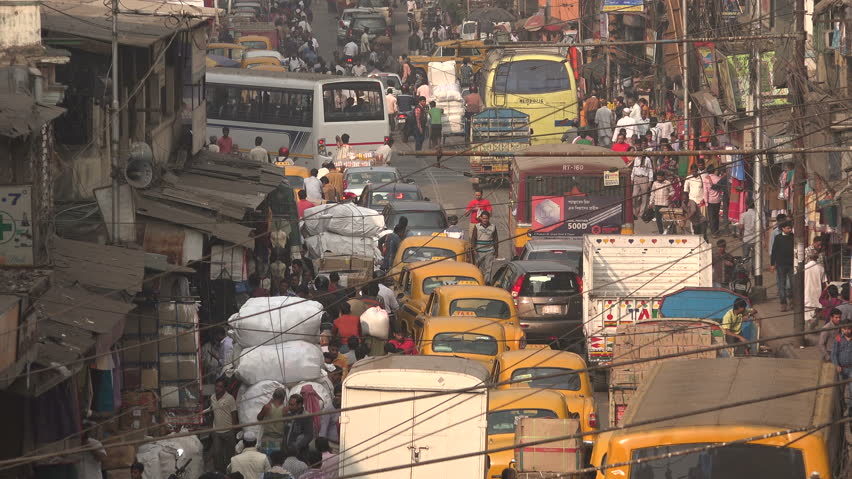
The West Bengal government is taking up a brave new project to set a target for the number of vehicles that Kolkata will be able to carry ideally. Policies to reduce and/or regulate vehicles will depend on the figure arrived at.
The state transport department is currently discussing the project with Indian Institute of Technology, Kharagpur. Preparing the modalities is now in the final stage.
Kolkata – with a 4.5 million population (2011 Census) and 0.741 million vehicles (according to government of India figures of 2016) – is among the most polluted cities in the world.
Read More: Gangasagar Mela: plastic-free, GPS fitted buses & vessels to cater over 20 lakh pilgrims
“There is need to tackle the city’s pollution and therefore a set of policies must be prepared to keep a check on the number of vehicles that should ply in the city. But this must have a scientific basis,” said state transport secretary Alapan Bandopadhyay.
The transport department is in talks with IIT Kharagpur to work on this very important project that can fix the number of vehicles that can ply in Kolkata and subsequent registration might depend on the conclusion of this study.
But wait! It’s not so alarming either.
Read More: Former Dum Dum resident elected London councillor
How to arrive at a certain number
A scientific basis of fixing the number or percentage of vehicles that can ply in the city is the “Target Mode Share”. It is a measure that helps city planners to set priorities of which kind of vehicle should be prioritised and to what degree, to reduce the level of pollution and traffic snarls, says Prof Bhargab Maitra, head of the Civil Engineering Department of IIT Kharagpur. Also important, Maitra says, is the “mode share” – that is, which modes of transport should be allowed more in comparison with other modes of transport. This may be identified as the “ideal mode share”. Should there be more buses than taxis (because buses can carry more people)? Should there be less two-wheelers? Should bicycle lanes be prepared in certain areas of the city?
“The study will be done from the point of view of the city’s ‘capacity’ – that is, how much vehicle it is capable of holding,” Maitra said. The starting point for the study will be key traffic intersections of Kolkata. Researchers will look at the waiting time at signals, the number of vehicles moving through the intersections every day, the level of pollution at these junctions, and so on. Conclusions may be drawn – based on these findings. Two things are important yardsticks here from the layman point of view – population and pollution.
“No overloading of the city can be allowed. Government policies – of allowing certain number of licence for specific modes of transport, can be arrived at from this point,” a senior transport department official said.
Number worries
In India, out of the total 230 million registered motor vehicles up to March, 2016, Maharashtra accounts for the largest share (12.1%) followed by Tamil Nadu (10.5%), Uttar Pradesh (10.4%), Gujarat (8.9%) and Karnataka (7.1%). These five states together account for 49 per cent of the total vehicles registered in the country.
The 51 million-plus cities have 70.93 million registered vehicles till March 2016, which is 31 per cent of total registered vehicles in India. Delhi (88.51 lakh) recorded the highest number of registered (motor) vehicles, followed by Bengaluru (61.13 lakh), Chennai (49.38 lakh), Ahmedabad (36.56 lakh), Greater Mumbai (28.20 lakh) and Surat (26.66 lakh). These six cities accounted for 41 per cent of the total registered vehicles in respect of the reported million-plus cities.
Kolkata may be behind these cities in terms of the number of vehicles registered and plying, but the need to tackle the pollution and vehicle number is essential nonetheless. While the number of buses were 6,020, taxis 49,098 and two-wheelers 3,13,508, the total number (including trucks and lorries, light motor vehicles (goods and passenger), taxis, buses, motor vehicles on hire, two wheelers, cars, jeeps, omni buses, tractors, trailers, other vehicles) was 7,40,879.
Currently, there are no policies on restricting licences or permits for modes of transport. It is rather arbitrary. So taxis, buses, private vehicles, app cabs easily get clearance from government. Naturally, the number is increasing every day. A Target Mode Share will bring a clear picture on what the ideal number of vehicles should be for the city.
Leave a Reply